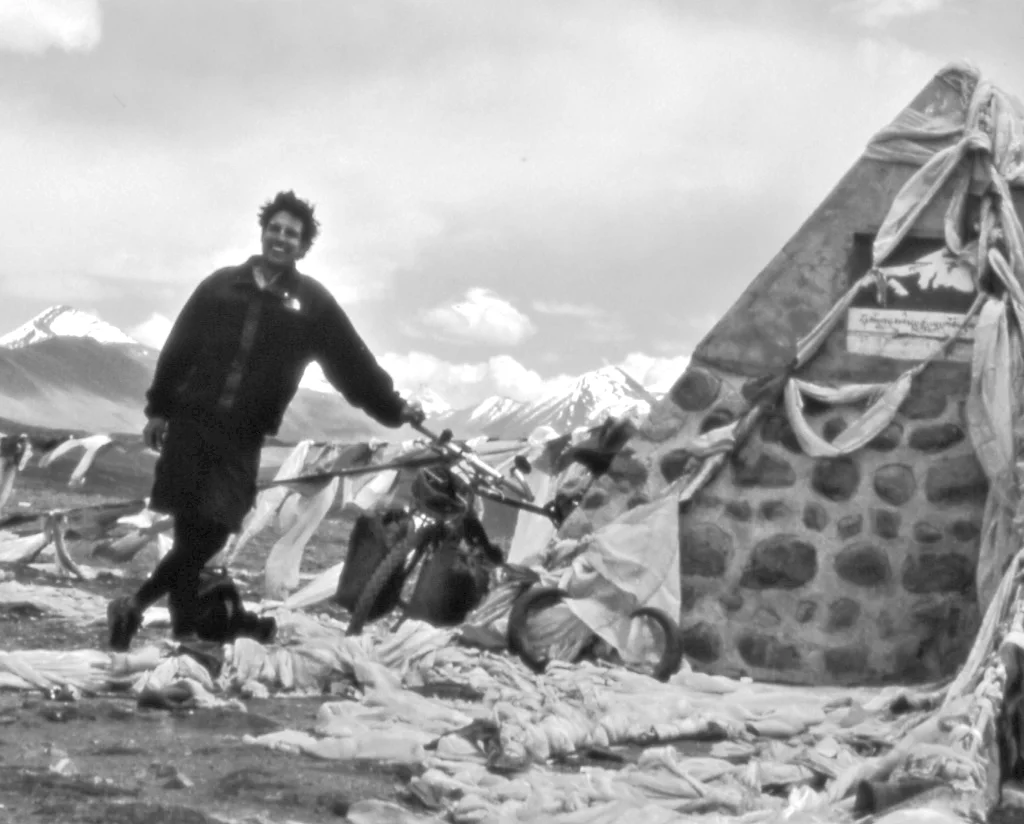
The author beside his loaded bicycle at a high pass strung with prayer flags, snow peaks behind.
On the Tibetan Plateau.

Cycle Nomad

Two years, fourteen thousand miles, a five hundred dollar bicycle. 1999 to 2001.

Nepal, 2000. A rural hospital. The sick lie on thin mats on the concrete. A man foams at the mouth. Others seize, and their families hold them down so their heads will not strike the floor. The air smells of what no one has cleaned.

No one hurries. A nurse steps around them without looking down. Whatever urgency this place once had was spent long ago.

Two hours, and no one has examined me. The pain comes in waves. Between them there is time to think, with a calm that is almost pleasant, that it has been a lucky life. I close my eyes and wait for the end.

I am twenty-three, and I am wrong about this, as about nearly everything that brought me here.

What brought me here

A plan. Ride around the world on a five hundred dollar bicycle, then return to Asia, shave my head, and spend the rest of my life as a Buddhist monk. I had read the sutras. I had meditated every day for years. I had ten thousand dollars and no doubts.

There was a second plan, which did not look like one. At home there was always another hoop. The examining could wait for the road. No house was waiting either, and I took that for freedom.

Kuala Lumpur, October 1999. Exhaust and fog at an intersection. A man on a moped hears my good morning and does not move his face. I am free. It feels like any other morning.

The first plan lasted until the first monastery, where the monks ate better than I did and the women of the village prostrated themselves before them on white tile. I had come looking for holiness. I had found an institution.

The second lasted longer, because it was easier to put off. Some mornings the tent was hard to leave. Some nights brought a fear with no object. After a full day in the silt of Laos the body would go still, quieted by having done something. By morning it was gone.

A man who must always be accomplishing something is usually a man without a home. It was years before I recognized the man.

The road

Not all of it was ridden. Where a border would not open, I flew.

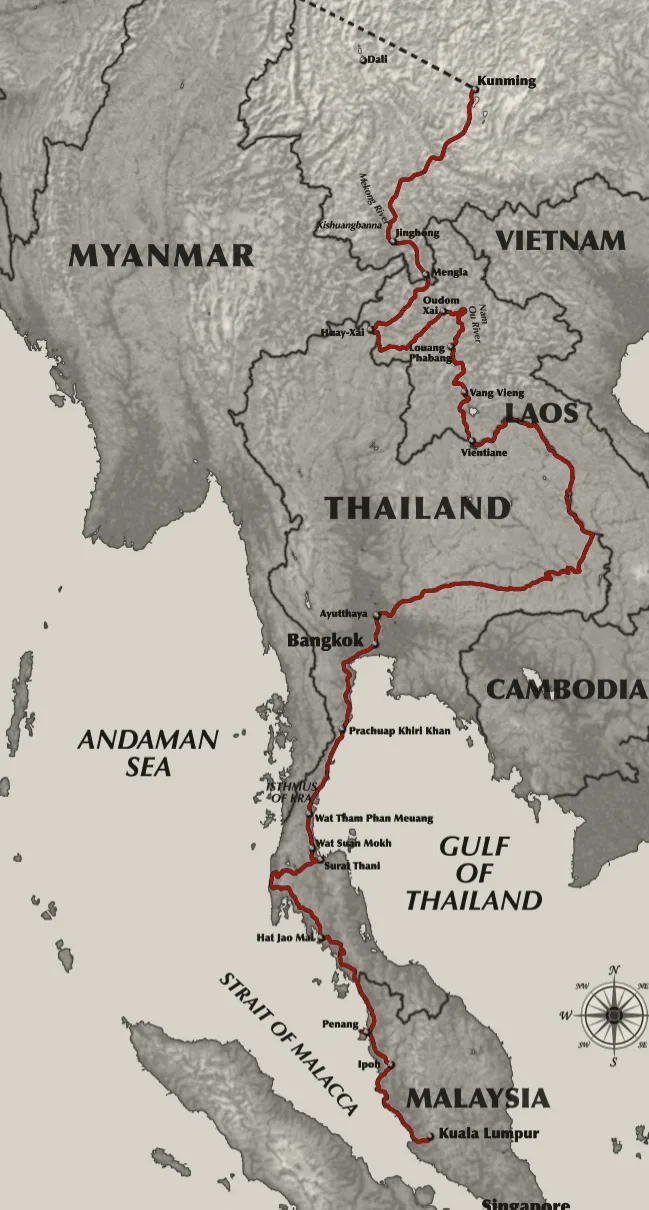
Route map from Kuala Lumpur north through Malaysia, Thailand and Laos to Kunming in China.
Kuala Lumpur to Kunming.

Malaysia to Tibet

On Pangkor a cloudburst traps a boatload of strangers under a tin roof. For a few seconds everything comes into focus: an old couple whispering, the shadow of a woman's cheekbone, a boy caught going through her bag. Then the rain stops, and it is gone.

In Thailand I pick up some Thai. In Laos soldiers guard the opium fields. A girl sees my face and screams “Falang!” Foreigner. The whole village runs inside.

I had come to Asia to dissolve the self. It turned out to be the only thing anyone could see.

China is the opposite. In the villages a crowd closes in; most have never seen a white face. Small children reach up to touch my hair. Some days it is too much. The first grey hairs come in China.

I want to quit nearly every day. The permit to ride from Chengdu to Lhasa is refused, and refused again. In the end I fly.

On the Tibetan Plateau the nomads laugh at me and pour me yak-butter tea, which is the worst thing I have ever tasted and the only thing they have to give.

Malaysia, Thailand, Laos, China, Tibet.
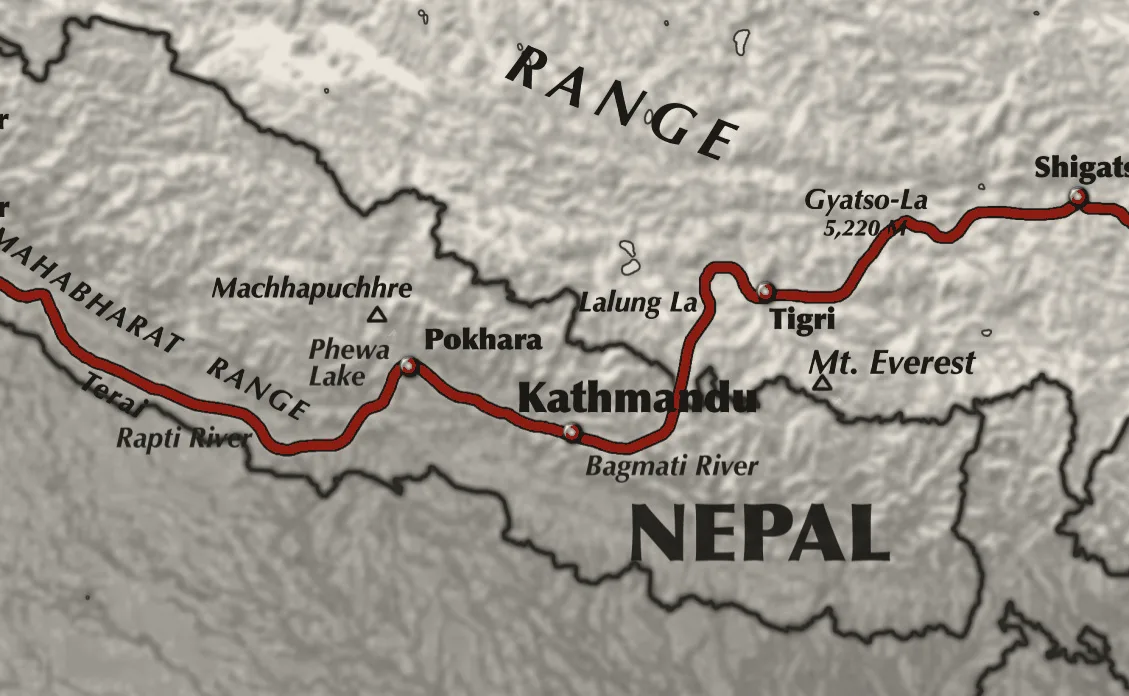
Route map from Shigatse over Gyatso-La and down through Kathmandu and Pokhara in Nepal.
Over the Himalaya into Nepal.

Nepal and India

From the top of the plateau the road falls toward Nepal. I leave it for the dirt and cut straight down the switchbacks built for trucks with weak engines. For one day there is nothing but speed and dust.

Then the hospital, and the appendix. Two months on my back, then the road again, down into India.

In a stone temple in the Himalaya a sadhu passes me his pipe. In Dharamsala I hear the Dalai Lama speak.

The town is full of young Israelis just out of the army and Western seekers trading one set of bells and incense for another. Translation, not transformation. It is easy to say what is wrong with it. Harder to say what I have instead. They at least have a form to give themselves to. I have the road.

Nepal, India.

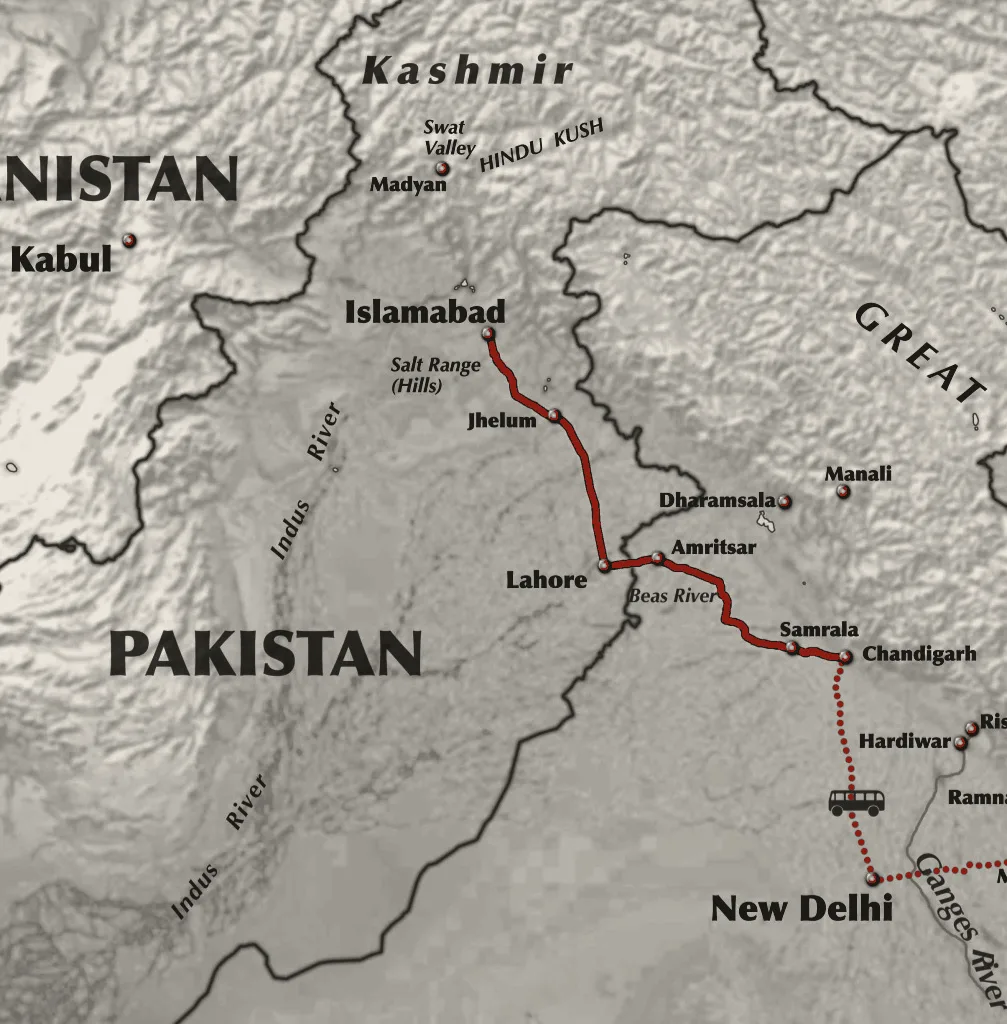
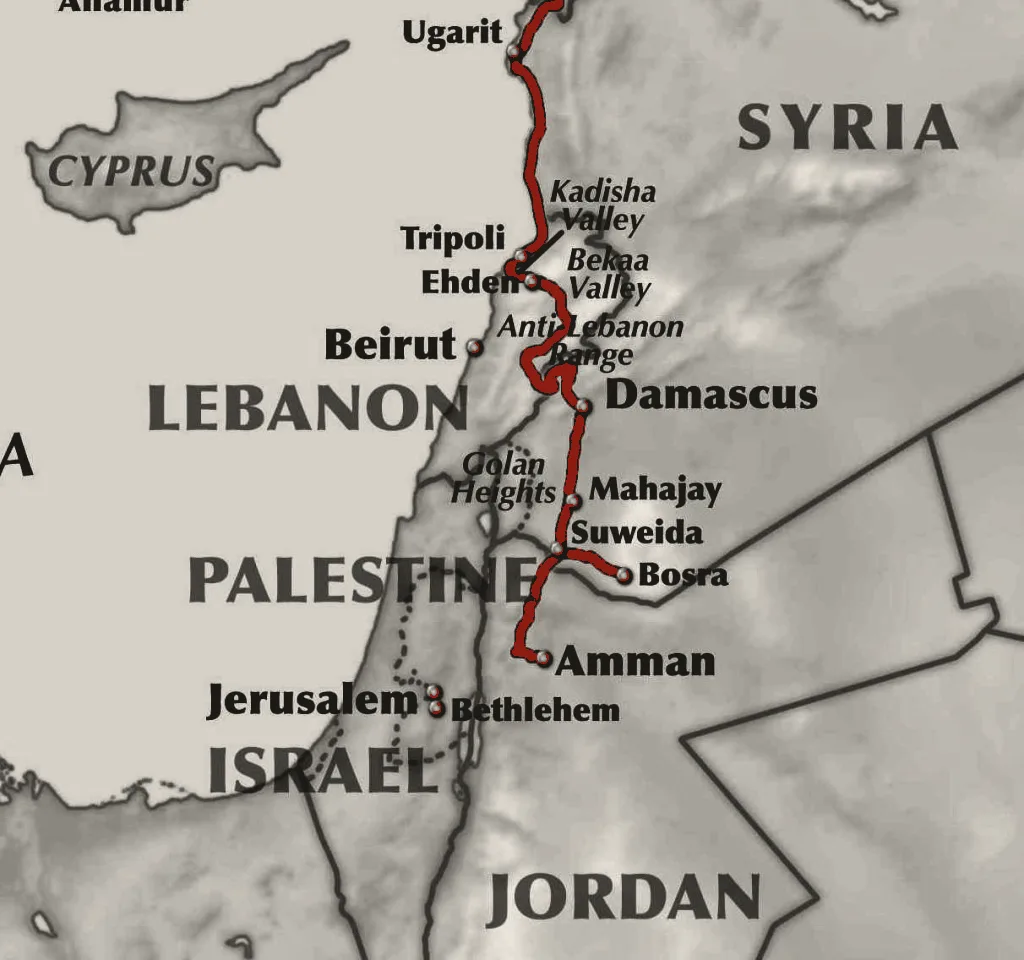
Route map across the Punjab from Delhi to Lahore and Islamabad, with the Swat Valley marked to the north. Route map from Amman north through Damascus, across the Anti-Lebanon range and up the coast past Tripoli.
The Punjab and the Swat Valley. Amman, Damascus, Lebanon.

Pakistan, Syria and Lebanon

The dust of Pakistan: chickens, bicycles, chaos, and everywhere someone offering tea. If I have a religion, it is this. The road does not move. You move on it and take what comes, bliss or fear, chaos or calm, and keep going.

The Swat Valley, years before the Taliban. Among strangers I keep seeing faces like my own. The history that put them there runs through me too.

The plan is to ride west. Iran refuses a visa, again and again. By October the way through Central Asia is closing. Saudi Arabia will not let me in. I fly from Islamabad to Amman.

Syria gives me the kindest welcome of the journey, except in the mountains, where the security men sip mate and look straight through me.

In a Shia mosque in Damascus I pray behind an imam until nothing is left but the prayer. I walk out under the stars certain I have finally understood.

Some days later, in the mountains of Lebanon, a man pours arak and makes me drink to the health of George W. Bush. Then he puts a gun to my head and orders me to ride into the dark.

Between the certainty and the gun: a few days, one mountain range.

Pakistan, Jordan, Syria, Lebanon.

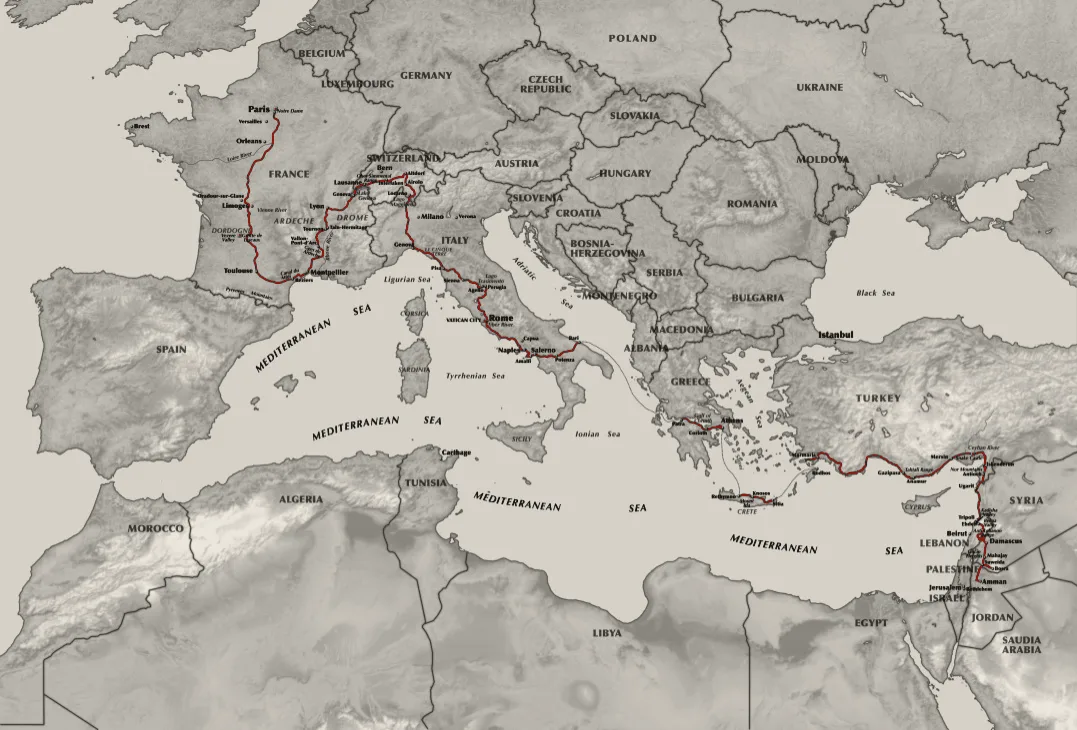
Route map of the Mediterranean crossing: southern Turkey, Crete and Greece, Italy, the Alps, Switzerland and France to Paris.
Antioch to Paris.

Turkey to France

Rhodes. White yachts wait out the winter, and in a youth hostel I read Thucydides: the strong do as they can, and the weak suffer as they must. I underline it, and for a long time I am sure it is about other people.

In the middle of Italy the bicycle falls apart, and so do I. I decide to walk to Rome and fly home. Then, through the salt and sunscreen in my eyes, a sign for a bicycle shop. A mechanic named Marzullo, hands flying above his head as he talks, takes me in like kin.

I keep riding. Over the Alps in a snowstorm. Across France beside my father. For a thousand kilometers the road gives us something we can share, and some days we laugh. It does not last. For a while it is enough.

Turkey, Greece, Italy, Switzerland, France.

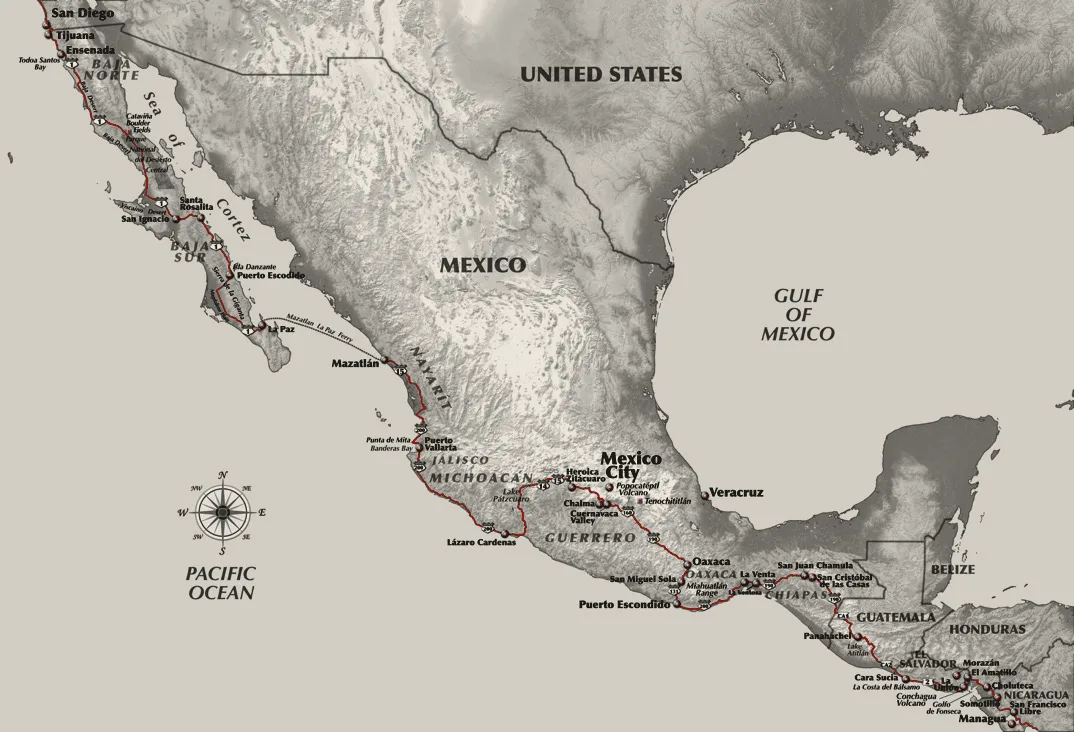
Route map from Managua north through Central America and Mexico, up the Baja peninsula to San Diego.
Managua to San Diego.

Panama to California

Honduras. Soldiers at the roadside: if you are robbed, do not fight. They kill.

In Chiapas I ride with Carlos, a young Nicaraguan going north at the risk of his life, toward the country I can fly home to whenever I like. For two years I have called this journey a quest. Beside his, it is a holiday with hardships.

By Mexico I speak Spanish. Above Cuernavaca the road turns to dirt and fills with pilgrims walking to the cave at Chalma, where the Aztecs prayed to the god of caves and their descendants now pray to Christ. An old man carries Him in a glass box as long as his back. God is a verb, Buckminster Fuller said. Here He is the walking.

In the fir forest of Michoacán the branches hang strangely low. Then the sun breaks through and they come apart: monarchs pouring down in an orange swirl, landing in my hair, on my back, on my legs. They winter here and fly north to breed and die, on a road no single butterfly finishes.

Darwin wrote of caged birds that throw themselves at the side of the cage facing their migration until they are bare and bloody. Our ancestors walked for ninety thousand years and settled only eleven thousand years ago. Perhaps what drives me is no more than that, an old instinct dressed in meaning. Or perhaps I have only collected extreme experiences, the way a graduate with a rail pass collects photographs of himself in front of cathedrals.

In the Baja desert a van passes at more than a hundred and twenty kilometers an hour and takes the mirror off my bicycle. The shock comes that night, in the dunes, where I lie shaking and watch the sand drift past like something leaving. The next morning I pass the same van in a ditch, blue tarp and all.

Panama, Costa Rica, Nicaragua, Honduras, El Salvador, Guatemala, Mexico.

Home

Southern California, 2001. Fourteen thousand miles.

At the border a customs officer asks the purpose of my travels. I have no answer he would write down.

On the last night I roll into my grandmother's driveway. For a moment before I get off the bicycle, I am the one standing still, and the world goes past on either side.

I have not become a monk. For a few months I am at ease in my own skin. Then it passes.

The road talked the whole way. I heard perhaps half of it. The rest arrived years later, a sentence at a time.

Where a border would not open, I bought a ticket over it. Carlos could not. It took years to see that the ticket was part of the story.

I hope my children never need a road like this one. I hope they miss the house.

The world that let me through

The roads are still on the map. Most of them are closed now to a foreigner on a bicycle. Syria went through a war that emptied its cities. Lebanon has been bombed again. The Taliban took the Swat Valley and were driven out. Tibet no longer lets an outsider ride alone. Honduras and the south of Mexico have grown harder.

I did not know I was seeing the last of something.

One never does.

The manuscript

There is a manuscript. It is unfinished, and I will come back to it. Until then, this page keeps a record of the road.